
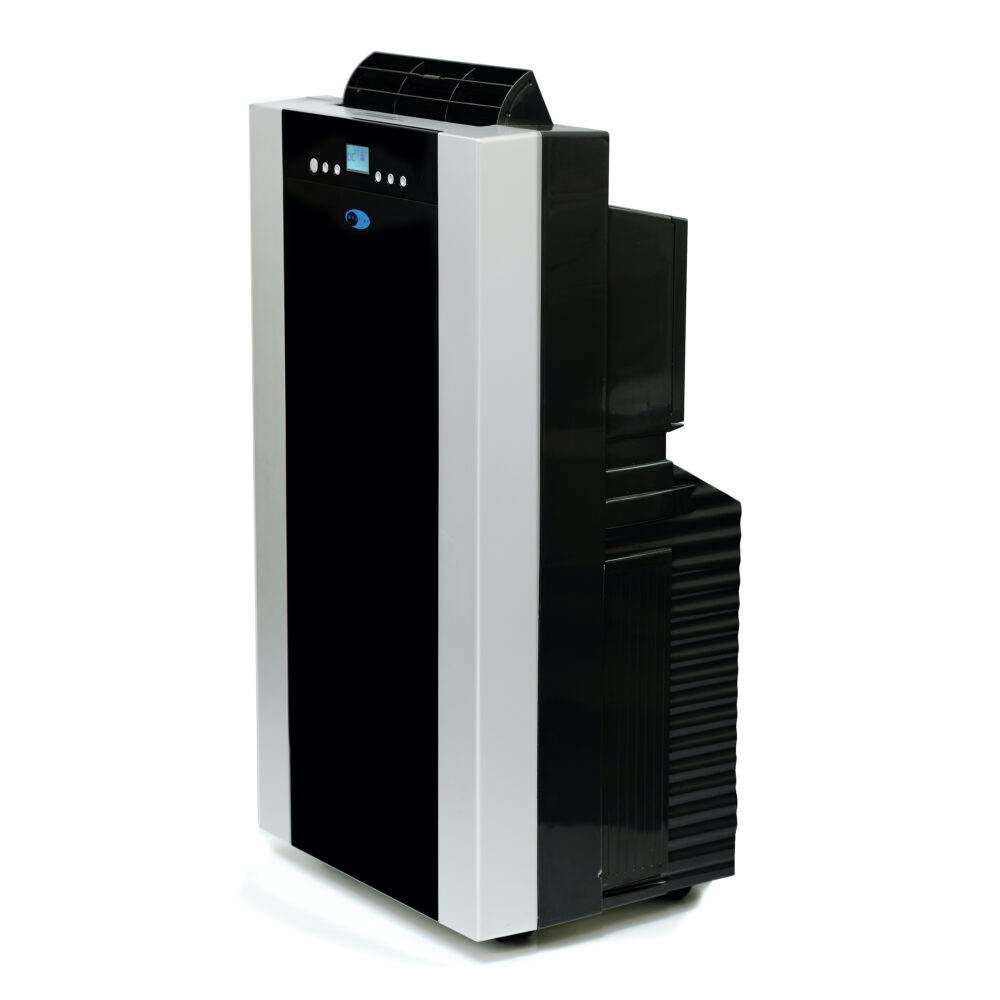
What it actually is
The Whynter ARC-14S is a full compressor-based portable air conditioner — not a fan, not an evaporative cooler, not a personal-cooling gadget. It's built to actually lower the temperature of a room by mechanically removing heat, the same basic principle as a window unit or central AC, just packaged to roll around and vent through a window kit. It carries a built-in dehumidifier function and a washable pre-filter, and is rated for rooms up to roughly 500 square feet.
Real background, not marketing copy
The BTU rating on the box is where most portable-AC shopping goes wrong, and Whynter's own listing shows both numbers, so we're going to slow down and explain them rather than repeat just one. The ARC-14S is rated 14,000 BTU under the older ASHRAE standard — a more generous number, and the one most marketing across this entire product category still leads with. It's also rated 9,500 BTU under SACC (Seasonally Adjusted Cooling Capacity), a newer, DOE-required standard introduced in 2017 that tests under more realistic conditions and produces a lower, more conservative figure. Neither number is "wrong" — they're measuring the same unit two different ways — but comparing BTU ratings across different products only makes sense when you're comparing the same rating type. A unit listing a 14,000 BTU ASHRAE figure against one listing a 9,500 BTU SACC figure isn't actually a fair comparison, even though it looks like one.
Where the ARC-14S earns its "Recommended" verdict is the dual-hose design. Most budget portable ACs use a single hose that both draws in air to cool the compressor and exhausts hot air outside — which, because the room is sealed, also pulls in a bit of untreated, hot outside air through every crack and gap to replace what's being exhausted, working against the unit's own cooling. The ARC-14S uses one hose to draw makeup air from outside for the intake side and a second to exhaust hot air, so the room isn't being depressurized the same way. That's a real, specific, testable engineering difference, not a marketing phrase — and it's part of why independent reviewers at RTINGS and TechGearLab, two named, checkable outlets, have reviewed the unit favorably.
Whynter LLC itself is a real, established small-appliance company, not a marketplace-only import brand assembled around a single trending SKU. It was founded in 2006 in California and has built out a genuine product catalog over that time — portable air conditioners, dehumidifiers, wine and beverage coolers, ice cream makers — the kind of steady, multi-category small-appliance business that's straightforward to verify.
What we're not repeating as verified fact: Whynter's own marketing page cites a "2025 Good Housekeeping Best Overall" mention, a "2024 TIME Stamped pick," and being "recognized by Wirecutter." We looked for independent confirmation of these specific claims outside of Whynter's own marketing and couldn't find it. That doesn't mean they're false — but we only repeat what we can verify ourselves, and these don't clear that bar yet, so we're naming them here and setting them aside rather than passing them along as fact.
Who this is (and isn't) right for
Good fit if... you want a real compressor AC that will actually cool a room rather than a token gesture at it, you have a workable window for the vent kit, and you don't mind roughly 75 pounds of appliance that's going to stay mostly in one place once it's set up.
Not the right pick if... you're hoping to wheel an AC between rooms often — the weight and the vent-hose setup work against that — or you don't have a window (or comparable opening) the vent kit can actually use.
Where to buy it
We're comfortable linking to this one: it's a genuine compressor AC from an established maker, with independently reviewed cooling performance and a documented, testable engineering advantage in the dual-hose design. The one real, repeated complaint in the field is about the awkward, shallow carry handles relative to the unit's weight — worth knowing going in, not a reason to avoid it.
See it on Amazon →As an Amazon Associate, Daily Wellness Chronicle earns from qualifying purchases. This link opens a live Amazon search for this exact product, not one specific listing we control — prices and sellers may vary.
FAQ
- Is 14,000 BTU or 9,500 BTU the "real" number?
- Both are real — they're just different measurement standards. 14,000 BTU is the older ASHRAE rating; 9,500 BTU is the newer, more conservative SACC rating the DOE has required since 2017. Use the same rating type when comparing across different portable ACs.
- Why does the dual-hose design matter?
- Single-hose units pull replacement air in through gaps around doors and windows as they exhaust hot air, working against their own cooling. The ARC-14S draws its makeup air from outside through a dedicated intake hose instead, which independent reviewers have found makes a measurable difference.
- Does it need a window?
- Yes — it needs a workable opening for the vent kit, typically a window. Without one, this isn't the right unit.
- How heavy is it, really?
- Around 75 pounds. It rolls on casters but the documented complaint pattern is about handle depth and grip relative to that weight, not about the wheels themselves.
Sources
- RTINGS.com, Whynter ARC-14S review
- TechGearLab, portable air conditioner testing coverage
- Whynter LLC, company and product specification pages
- U.S. Department of Energy, SACC (Seasonally Adjusted Cooling Capacity) rating standard, effective 2017